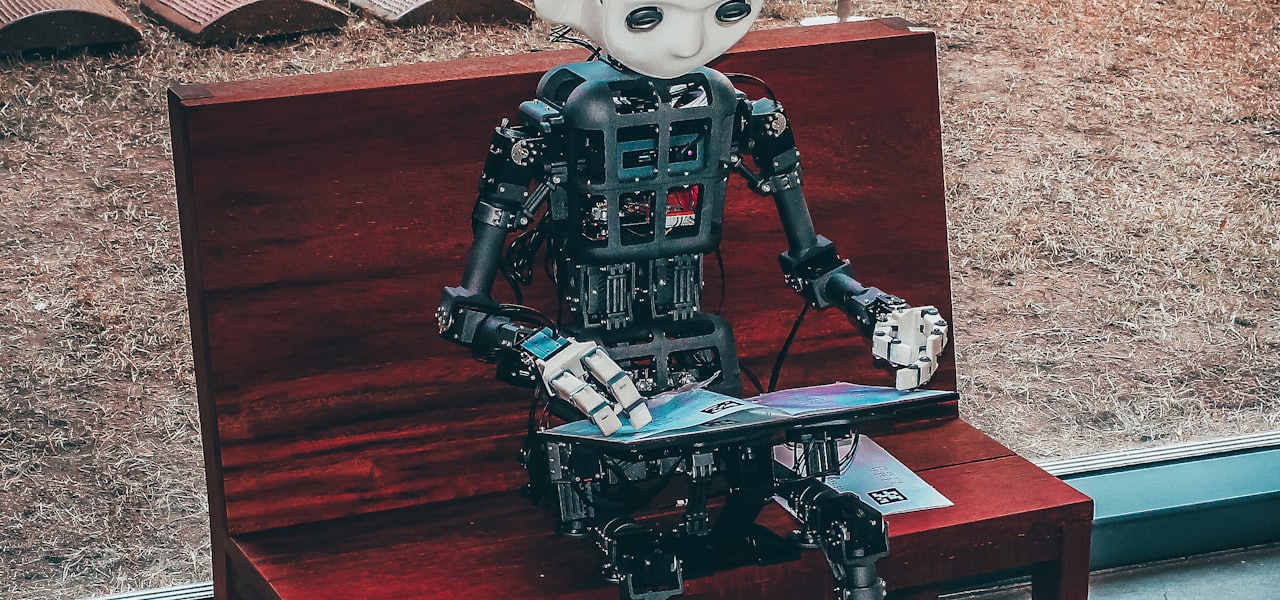
In artificial intelligence and cognitive science, the term situated refers to an agent which is embedded in an environment. The term situated is commonly used to refer to robots, but some researchers argue that software agents can also be situated if: they exist in a dynamic (rapidly changing) environment, which they can manipulate or change through their actions, and which they can sense or perceive. Examples might include web-based agents, which can alter data or trigger processes (such as purchases) over the internet, or virtual-reality bots which inhabit and change virtual worlds, such as Second Life. Being situated is generally considered to be part of being embodied, but it is useful to consider each perspective individually. The situated perspective emphasizes that intelligent behaviour derives from the environment and the agent's interactions with it. The nature of these interactions are defined by an agent's embodiment.
Reflection lines
Engineers use reflection lines to judge a surface's quality. Reflection lines reveal surface flaws, particularly discontinuities in normals indicating that the surface is not C 2 {\displaystyle C^{2}} . Reflection lines may be created and examined on physical surfaces or virtual surfaces with the help of computer graphics. For example, the shiny surface of an automobile body is illuminated with reflection lines by surrounding the car with parallel light sources. Virtually, a surface can be rendered with reflection lines by modulating the surfaces point-wise color according to a simple calculation involving the surface normal, viewing direction and a square wave environment map. == Mathematical definition == Consider a point p {\displaystyle p} on a surface M {\displaystyle M} with (normalized) normal n {\displaystyle n} . If an observer views this point from infinity at view direction v {\displaystyle v} then the reflected view direction r {\displaystyle r} is: r = v − 2 ( n ⋅ v ) n . {\displaystyle r=v-2(n\cdot v)n.} (The vector v {\displaystyle v} is decomposed into its normal part v n = ( n ⋅ v ) v {\displaystyle v_{n}=(n\cdot v)v} and tangential part v t = v − v n {\displaystyle v_{t}=v-v_{n}} . Upon reflection, the tangential part is kept and the normal part is negated.) For reflection lines we consider the surface M {\displaystyle M} surrounded by parallel lines with direction a {\displaystyle a} , representing infinite, non-dispersive light sources. For each point p {\displaystyle p} on M {\displaystyle M} we determine which line is seen from direction v {\displaystyle v} . The position on each line is of no interest. Define the vector r p {\displaystyle r_{p}} to be the reflection direction r {\displaystyle r} projected onto a plane P {\displaystyle P} that is orthogonal to a {\displaystyle a} : r p = r − ( r ⋅ a ) a {\displaystyle r_{p}=r-(r\cdot a)a} and similarly let v p {\displaystyle v_{p}} be the viewing direction projected onto P {\displaystyle P} : v p = v − ( v ⋅ a ) a {\displaystyle v_{p}=v-(v\cdot a)a} Finally, define v o {\displaystyle v_{o}} to be the direction lying in P {\displaystyle P} perpendicular to a {\displaystyle a} and v p {\displaystyle v_{p}} : v o = a × v p {\displaystyle v_{o}=a\times v_{p}} Using these vectors, the reflection line function θ ( p ) : M → ( − π , π ] {\displaystyle \theta (p):M\rightarrow (-\pi ,\pi ]} is a scalar function mapping points p {\displaystyle p} on the surface to angles between v p {\displaystyle v_{p}} and r p {\displaystyle r_{p}} : θ = arctan ( r p ⋅ v o , r p ⋅ v p ) {\displaystyle \theta =\arctan {(r_{p}\cdot v_{o},r_{p}\cdot v_{p})}} where a r c t a n ( y , x ) {\displaystyle arctan(y,x)} is the atan2 function producing a number in the range ( − π , π ] {\displaystyle (-\pi ,\pi ]} . ( v p {\displaystyle v_{p}} and v o {\displaystyle v_{o}} can be viewed as a local coordinate system in P {\displaystyle P} with x {\displaystyle x} -axis in direction v p {\displaystyle v_{p}} and y {\displaystyle y} -axis in direction v o {\displaystyle v_{o}} .) Finally, to render the reflection lines positive values θ > 0 {\displaystyle \theta >0} are mapped to a light color and non-positive values to a dark color. == Highlight lines == Highlight lines are a view-independent alternative to reflection lines. Here the projected normal is directly compared against some arbitrary vector x {\displaystyle x} perpendicular to the light source: θ = arctan ( n a ⋅ a ⊥ , n a ⋅ x ) {\displaystyle \theta =\arctan {(n_{a}\cdot a^{\perp },n_{a}\cdot x)}} where n a {\displaystyle n_{a}} is the surface normal projected on the light source plane P {\displaystyle P} : n a ^ / | n a ^ | , n a ^ = n − ( n ⋅ a ) a {\displaystyle {\hat {n_{a}}}/|{\hat {n_{a}}}|,{\hat {n_{a}}}=n-(n\cdot a)a} The relationship between reflection lines and highlight lines is likened to that between specular and diffuse shading.
Digital zombie
A digital zombie is a person so engaged with digital technology or social media they are unable to separate themselves from a persistent online presence. Writing in 2017, University of Sydney researcher Andrew Campbell expressed concerns over whether or not the individual can truly live a full and healthy life while they are preoccupied with the digital world. Other individuals have also begun referencing certain types of behaviour with being a digital zombie. Stefanie Valentic, managing editor of EHS Today, refers to it as people hunting digital creatures through their smartphones in public spaces, always fixed on their phones. The University of Warwick has used the term to argue that further research needs to be done with people who exist in digital form after death to help people grieve their loss. == Modern applications == === Distracted walking === The term digital zombie can refer to a person performing distracted walking, which has been labelled dangerous by the American Academy of Orthopaedic Surgeons. They created the "Digital Deadwalkers" campaign after physicians became aware of the risks associated with walking across intersections and sidewalks while paying attention only to smartphones and not one's surroundings. Also stating that the name is derived from the fact that "they're oblivious to everyone else, so it's like they're dead-walking, sleepwalking." === Living through media === The Department of Sociology, University of Warwick has also identified the term, digital zombie, to refer to an individual who has died but is digitally resurrected, reanimated and socially active. These digital zombies do things in death they did not do when they were alive as they "live" again through a digital self on a digital medium. Dead celebrities sometimes become digital zombies when they are reanimated to appear in commercial advertisements (such as Audrey Hepburn and Bob Monkhouse). Other accidental digital zombies include Tupac Shakur and Michael Jackson who were both digitally resurrected and recreated to perform "live" on stage years after their death. Researchers at the University of Warwick have carried out research into the area of human-computer interaction. in an effort to understand the affect these digital zombies have on grief and bereavement. === Mobile gaming === Writer for EHS Today, Stefanie Valentic, has made observations with the mobile phone video game Pokémon Go, which offers players the experience to hunt and collect digital creatures called Pokémon through their smartphone in real world. Players can be observed simultaneously gazing at their phone while also obliviously walking around their environments looking for Pokémon. Stefanie references these individuals as "digital zombies" since they walk around with no cognition of their surroundings while engaged with their phone. == Health risks == === Heavy use of technology === Research by the University of Sydney has begun looking at how new technology such as digital media and smartphones impact our lives and questioning whether they can create new compulsions and obsessions. The research demonstrates that increased heavy technological use can have negative health consequences similar to drugs, smoking, and alcohol. Marcel O'Gorman, an associate professor of English at the University of Waterloo, has commented on the body of research examining how technology impacts cognition, stating currently that there is no empirical evidence to support any theories that suggest that technology can damage memory and attention span. === Heightened risk to children === Manfred Spitzer, a German psychiatrist, has raised concerns with providing digital devices to children. During the early childhood stage while their brains are rapidly growing, increased exposure to digital devices may deprive them of necessary development required to facilitate brain growth. These concerns are also shared by Korean doctors who believe giving digital devices, like smartphones to children, limits their cognitive development.
Kimchi (software)
Kimchi is a web management tool to manage Kernel-based Virtual Machine (KVM) infrastructure. Developed with HTML5, Kimchi is developed to intuitively manage KVM guests, create storage pools, manage network interfaces (bridges, VLANs, NAT), and perform other related tasks. The name is an extended acronym for KVM infrastructure management. It is an Apache-licensed project hosted on GitHub, and incubated by oVirt.org.
Timeline of operating systems
This article presents a timeline of events in the history of computer operating systems from 1951 to the current day. For a narrative explaining the overall developments, see the History of operating systems. == 20th Century == == 1940s == 1949 EDSAC was considered the first operating system developed by Maurice Wilkes and manufactured by the University of Cambridge == 1950s == 1951 LEO I 'Lyons Electronic Office' was the commercial development of EDSAC computing platform, supported by British firm J. Lyons and Co. 1953 DYSEAC - an early machine capable of distributing computing 1955 General Motors Operating System made for IBM 701 MIT's Tape Director operating system made for UNIVAC 1103 1956 GM-NAA I/O for IBM 704, based on General Motors Operating System 1957 Atlas Supervisor (Manchester University) (Atlas computer project start) BESYS (Bell Labs), for IBM 704, later IBM 7090 and IBM 7094 1958 University of Michigan Executive System (UMES), for IBM 704, 709, and 7090 1959 SHARE Operating System (SOS), based on GM-NAA I/O == 1960s == 1960 IBSYS (IBM for its 7090 and 7094) 1961 CTSS demonstration (MIT's Compatible Time-Sharing System for the IBM 7094) MCP (Burroughs Master Control Program) for B5000 1962 Atlas Supervisor (Manchester University) (Atlas computer commissioned) BBN Time-Sharing System GCOS (GE's General Comprehensive Operating System, originally GECOS, General Electric Comprehensive Operating Supervisor) 1963 ADMIRAL AN/FSQ-32, another early time-sharing system begun CTSS becomes operational (MIT's Compatible Time-Sharing System for the IBM 7094) JOSS, an interactive time-shared system that did not distinguish between operating system and language Titan Supervisor, early time-sharing system begun 1964 Berkeley Timesharing System (for Scientific Data Systems' SDS 940) Chippewa Operating System (for CDC 6600 supercomputer) Dartmouth Time-Sharing System (Dartmouth College's DTSS for GE computers) EXEC 8 (UNIVAC) KDF9 Timesharing Director (English Electric) – an early, fully hardware secured, fully pre-emptive process switching, multi-programming operating system for KDF9 (originally announced in 1960) OS/360 (IBM's primary OS for its S/360 series) (announced) PDP-6 Monitor (DEC) descendant renamed TOPS-10 in 1970 SCOPE (CDC 3000 series) 1965 BOS/360 (IBM's Basic Operating System) DECsys TOS/360 (IBM's Tape Operating System) Livermore Time Sharing System (LTSS) Multics (MIT, GE, Bell Labs for the GE-645) (announced) Pick operating system SIPROS 66 (Simultaneous Processing Operating System) THE multiprogramming system (Technische Hogeschool Eindhoven) development TSOS (later VMOS) (RCA) 1966 DOS/360 (IBM's Disk Operating System) GEORGE 1 & 2 for ICT 1900 series Mod 1 Mod 2 Mod 8 MS/8 (Richard F. Lary's DEC PDP-8 system) MSOS (Mass Storage Operating System) OS/360 (IBM's primary OS for its S/360 series) PCP and MFT (shipped) RAX Remote Users of Shared Hardware (RUSH), a time-sharing system developed by Allen-Babcock for the IBM 360/50 SODA for Elwro's Odra 1204 Universal Time-Sharing System (XDS Sigma series) 1967 CP-40, predecessor to CP-67 on modified IBM System/360 Model 40 CP-67 (IBM, also known as CP/CMS) Conversational Programming System (CPS), an IBM time-sharing system under OS/360 Michigan Terminal System (MTS) (time-sharing system for the IBM S/360-67 and successors) ITS (MIT's Incompatible Timesharing System for the DEC PDP-6 and PDP-10) OS/360 MVT ORVYL (Stanford University's time-sharing system for the IBM S/360-67) TSS/360 (IBM's Time-sharing System for the S/360-67, never officially released, canceled in 1969 and again in 1971) WAITS (SAIL, Stanford Artificial Intelligence Laboratory, time-sharing system for DEC PDP-6 and PDP-10, later TOPS-10) 1968 Airline Control Program (ACP) (IBM) B1 (NCR Century series) CALL/360, an IBM time-sharing system for System/360 HP Real-Time Executive (HP RTE) – Hewlett-Packard HP Time-Shared BASIC (HP TSB) – Hewlett-Packard (time-sharing system for the HP 2000) THE multiprogramming system (Eindhoven University of Technology) publication TSS/8 (DEC for the PDP-8) VP/CSS 1969 B2 (NCR Century series) B3 (NCR Century series) GEORGE 3 For ICL 1900 series MINIMOP Multics (MIT, GE, Bell Labs for the GE-645 and later the Honeywell 6180) (opened for paying customers in October) RC 4000 Multiprogramming System (RC) TENEX (Bolt, Beranek and Newman for DEC systems, later TOPS-20) Unics (later Unix) (AT&T, initially on DEC computers) Xerox Operating System == 1970s == 1970 DOS-11 (PDP-11) 1971 EMAS Kronos RSTS-11 2A-19 (First released version; PDP-11) RSX-15 OS/8 1972 B4 (NCR Century series) COS-300 Data General RDOS Edos MUSIC/SP OS/4 OS 1100 OS/2000 (Honeywell 2000-series) Operating System/Virtual Storage 1 (OS/VS1) Operating System/Virtual Storage 2 R1 (OS/VS2 SVS) PRIMOS (written in FORTRAN IV, that didn't have pointers, while later versions, around version 18, written in a version of PL/I, called PL/P) Virtual Machine/Basic System Extensions Program Product (BSEPP or VM/SE) Virtual Machine/System Extensions Program Product (SEPP or VM/BSE) Virtual Machine Facility/370 (VM/370), sometimes known as VM/CMS 1973 Эльбрус-1 (Elbrus-1) – Soviet computer – created using high-level language uЭль-76 (AL-76/ALGOL 68) Alto OS CP-V (Control Program V) RSX-11D RT-11 VME – implementation language S3 (ALGOL 68) 1974 ACOS-2 (NEC) ACOS-4 ACOS-6 CP/M DOS-11 V09-20C (Last stable release, June 1974) Hydra – capability-based, multiprocessing OS kernel MONECS Multi-Programming Executive (MPE) – Hewlett-Packard Operating System/Virtual Storage 2 R2 (MVS) OS/7 OS/16 OS/32 Sintran III 1975 BS2000 V2.0 (First released version) COS-350 ISIS NOS (Control Data Corporation) OS/3 (Univac) VS/9 (formerly RCA's TSOS, later named VMOS) Version 6 Unix XVM/DOS XVM/RSX 1976 Cambridge CAP computer – all operating system procedures written in ALGOL 68C, with some closely associated protected procedures in BCPL Cray Operating System DX10 FLEX TOPS-20 TX990/TXDS Tandem Nonstop OS v1 Thoth 1977 1BSD AMOS KERNAL OASIS operating system OS68 OS4000 RMX-80 System 88 (Exec) System Support Program (IBM System/34 and System/36) TRSDOS Virtual Memory System (VMS) V1.0 (Initial commercial release, October 25) VRX (Virtual Resource eXecutive) VS Virtual Memory Operating System 1978 2BSD Apple DOS Control Program Facility (IBM System/38) Cray Time Sharing System (CTSS) DPCX (IBM) DPPX (IBM) HDOS KSOS – secure OS design from Ford Aerospace KVM/370 – security retro-fit of IBM VM/370 Lisp machine (CADR) MVS/System Extensions (MVS/SE) OS4 (Naked Mini 4) PTDOS TRIPOS UCSD p-System (First released version) Z80-RIO 1979 Atari DOS 3BSD CP-6 Idris MP/M MVS/System Extensions R2 (MVS/SE2) NLTSS POS Sinclair BASIC Transaction Processing Facility (TPF) (IBM) UCLA Secure UNIX – an early secure UNIX OS based on security kernel UNIX/32V DOS/VSE Version 7 Unix == 1980s == 1980 86-DOS AOS/VS (Data General) Business Operating System CTOS DOSPLUS (TRS-80) MVS/System Product (MVS/SP) V1 NewDos/80 OS-9 RMX-86 RS-DOS SOS Virtual Machine/System Product (VM/SP) Xenix 1981 Acorn MOS Aegis SR1 (First Apollo/DOMAIN systems shipped on March 27) CP/M-86 DRX (Distributed Resource Executive) iMAX – OS for Intel's iAPX 432 capability machine MCS (Multi-user Control System) MS-DOS PC DOS Pilot (Xerox Star operating system) UNOS UTS V VERSAdos VRTX VSOS (Virtual Storage Operating System) Xinu first release 1982 Commodore DOS LDOS (By Logical Systems, Inc. – for the Radio Shack TRS-80 Models I, II & III) PCOS (Olivetti M20) pSOS QNX Stratus VOS Sun UNIX (later SunOS) 0.7 Ultrix Unix System III VAXELN 1983 Coherent DNIX EOS GNU (project start) Lisa Office System 7/7 LOCUS – UNIX compatible, high reliability, distributed OS MVS/System Product V2 (MVS/Extended Architecture, MVS/XA) Novell NetWare (S-Net) PERPOS ProDOS RTU (Real-Time Unix) STOP – TCSEC A1-class, secure OS for SCOMP hardware SunOS 1.0 VSE/System Package (VSE/SP) Version 1 1984 AMSDOS CTIX (Unix variant) DYNIX Mac OS (System 1.0) MSX-DOS NOS/VE PANOS PC/IX ROS Sinclair QDOS SINIX UNICOS Venix 2.0 Virtual Machine/Extended Architecture Migration Assistance (VM/XA MA) 1985 AmigaOS Atari TOS DG/UX DOS Plus Graphics Environment Manager Harmony MacOS 2 MIPS RISC/os Oberon – written in Oberon SunOS 2.0 Version 8 Unix Virtual Machine/Extended Architecture System Facility (VM/XA SF) Windows 1.0 Windows 1.01 Xenix 2.0 1986 AIX 1.0 Cronus distributed OS FlexOS GEMSOS – TCSEC A1-class, secure kernel for BLACKER VPN & GTNP GEOS Genera 7.0 HP-UX MacOS 3 SunOS 3.0 TR-DOS TRIX Version 9 Unix 1987 Arthur (much improved version came in 1989 under the name RISC OS) BS2000 V9.0 IRIX (3.0 is first SGI version) MacOS 4 MacOS 5 MDOS MINIX 1.0 OS/2 (1.0) PC-MOS/386 Topaz – semi-distributed OS for DEC Firefly workstation written in Modula-2+ and garbage collected VxWorks Windows 2.0 1988 A/UX (Apple Computer) AOS/VS II (Data General) CP/M rebranded as DR-DOS Flex machine – tagged, capability machine with OS and other software written
Pixel-art scaling algorithms
Pixel art scaling algorithms are graphical filters that attempt to enhance the appearance of hand-drawn 2D pixel art graphics. These algorithms are a form of automatic image enhancement. Pixel art scaling algorithms employ methods significantly different than the common methods of image rescaling, which have the goal of preserving the appearance of images. As pixel art graphics are commonly used at very low resolutions, they employ careful coloring of individual pixels. This results in graphics that rely on a high amount of stylized visual cues to define complex shapes. Several specialized algorithms have been developed to handle re-scaling of such graphics. These specialized algorithms can improve the appearance of pixel-art graphics, but in doing so they introduce changes. Such changes may be undesirable, especially if the goal is to faithfully reproduce the original appearance. Since a typical application of this technology is improving the appearance of fourth-generation and earlier video games on arcade and console emulators, many pixel art scaling algorithms are designed to run in real-time for sufficiently small input images at 60-frames per second. This places constraints on the type of programming techniques that can be used for this sort of real-time processing. Many work only on specific scale factors. 2× is the most common scale factor, while 3×, 4×, 5×, and 6× exist but are less used. == Algorithms == === SAA5050 'Diagonal Smoothing' === The Mullard SAA5050 Teletext character generator chip (1980) used a primitive pixel scaling algorithm to generate higher-resolution characters on the screen from a lower-resolution representation from its internal ROM. Internally, each character shape was defined on a 5 × 9 pixel grid, which was then interpolated by smoothing diagonals to give a 10 × 18 pixel character, with a characteristically angular shape, surrounded to the top and the left by two pixels of blank space. The algorithm only works on monochrome source data, and assumes the source pixels will be logically true or false depending on whether they are 'on' or 'off'. Pixels 'outside the grid pattern' are assumed to be off. The algorithm works as follows: A B C --\ 1 2 D E F --/ 3 4 1 = B | (A & E & !B & !D) 2 = B | (C & E & !B & !F) 3 = E | (!A & !E & B & D) 4 = E | (!C & !E & B & F) Note that this algorithm, like the Eagle algorithm below, has a flaw: If a pattern of 4 pixels in a hollow diamond shape appears, the hollow will be obliterated by the expansion. The SAA5050's internal character ROM carefully avoids ever using this pattern. The degenerate case: becomes: === EPX/Scale2×/AdvMAME2× === Eric's Pixel Expansion (EPX) is an algorithm developed by Eric Johnston at LucasArts around 1992, when porting the SCUMM engine games from the IBM PC (which ran at 320 × 200 × 256 colors) to the early color Macintosh computers, which ran at more or less double that resolution. The algorithm works as follows, expanding P into 4 new pixels based on P's surroundings: 1=P; 2=P; 3=P; 4=P; IF C==A => 1=A IF A==B => 2=B IF D==C => 3=C IF B==D => 4=D IF of A, B, C, D, three or more are identical: 1=2=3=4=P Later implementations of this same algorithm (as AdvMAME2× and Scale2×, developed around 2001) are slightly more efficient but functionally identical: 1=P; 2=P; 3=P; 4=P; IF C==A AND C!=D AND A!=B => 1=A IF A==B AND A!=C AND B!=D => 2=B IF D==C AND D!=B AND C!=A => 3=C IF B==D AND B!=A AND D!=C => 4=D AdvMAME2× is available in DOSBox via the scaler=advmame2x dosbox.conf option. The AdvMAME4×/Scale4× algorithm is just EPX applied twice to get 4× resolution. ==== Scale3×/AdvMAME3× and ScaleFX ==== The AdvMAME3×/Scale3× algorithm (available in DOSBox via the scaler=advmame3x dosbox.conf option) can be thought of as a generalization of EPX to the 3× case. The corner pixels are calculated identically to EPX. 1=E; 2=E; 3=E; 4=E; 5=E; 6=E; 7=E; 8=E; 9=E; IF D==B AND D!=H AND B!=F => 1=D IF (D==B AND D!=H AND B!=F AND E!=C) OR (B==F AND B!=D AND F!=H AND E!=A) => 2=B IF B==F AND B!=D AND F!=H => 3=F IF (H==D AND H!=F AND D!=B AND E!=A) OR (D==B AND D!=H AND B!=F AND E!=G) => 4=D 5=E IF (B==F AND B!=D AND F!=H AND E!=I) OR (F==H AND F!=B AND H!=D AND E!=C) => 6=F IF H==D AND H!=F AND D!=B => 7=D IF (F==H AND F!=B AND H!=D AND E!=G) OR (H==D AND H!=F AND D!=B AND E!=I) => 8=H IF F==H AND F!=B AND H!=D => 9=F There is also a variant improved over Scale3× called ScaleFX, developed by Sp00kyFox, and a version combined with Reverse-AA called ScaleFX-Hybrid. === Eagle === Eagle works as follows: for every in pixel, we will generate 4 out pixels. First, set all 4 to the color of the pixel we are currently scaling (as nearest-neighbor). Next look at the three pixels above, to the left, and diagonally above left: if all three are the same color as each other, set the top left pixel of our output square to that color in preference to the nearest-neighbor color. Work similarly for all four pixels, and then move to the next one. Assume an input matrix of 3 × 3 pixels where the centermost pixel is the pixel to be scaled, and an output matrix of 2 × 2 pixels (i.e., the scaled pixel) first: |Then . . . --\ CC |S T U --\ 1 2 . C . --/ CC |V C W --/ 3 4 . . . |X Y Z | IF V==S==T => 1=S | IF T==U==W => 2=U | IF V==X==Y => 3=X | IF W==Z==Y => 4=Z Thus if we have a single black pixel on a white background it will vanish. This is a bug in the Eagle algorithm but is solved by other algorithms such as EPX, 2xSaI, and HQ2x. === 2×SaI === 2×SaI, short for 2× Scale and Interpolation engine, was inspired by Eagle. It was designed by Derek Liauw Kie Fa, also known as Kreed, primarily for use in console and computer emulators, and it has remained fairly popular in this niche. Many of the most popular emulators, including ZSNES and VisualBoyAdvance, offer this scaling algorithm as a feature. Several slightly different versions of the scaling algorithm are available, and these are often referred to as Super 2×SaI and Super Eagle. The 2xSaI family works on a 4 × 4 matrix of pixels where the pixel marked A below is scaled: I E F J G A B K --\ W X H C D L --/ Y Z M N O P For 16-bit pixels, they use pixel masks which change based on whether the 16-bit pixel format is 565 or 555. The constants colorMask, lowPixelMask, qColorMask, qLowPixelMask, redBlueMask, and greenMask are 16-bit masks. The lower 8 bits are identical in either pixel format. Two interpolation functions are described: INTERPOLATE(uint32 A, UINT32 B). -- linear midpoint of A and B if (A == B) return A; return ( ((A & colorMask) >> 1) + ((B & colorMask) >> 1) + (A & B & lowPixelMask) ); Q_INTERPOLATE(uint32 A, uint32 B, uint32 C, uint32 D) -- bilinear interpolation; A, B, C, and D's average x = ((A & qColorMask) >> 2) + ((B & qColorMask) >> 2) + ((C & qColorMask) >> 2) + ((D & qColorMask) >> 2); y = (A & qLowPixelMask) + (B & qLowPixelMask) + (C & qLowPixelMask) + (D & qLowPixelMask); y = (y >> 2) & qLowPixelMask; return x + y; The algorithm checks A, B, C, and D for a diagonal match such that A==D and B!=C, or the other way around, or if they are both diagonals or if there is no diagonal match. Within these, it checks for three or four identical pixels. Based on these conditions, the algorithm decides whether to use one of A, B, C, or D, or an interpolation among only these four, for each output pixel. The 2xSaI arbitrary scaler can enlarge any image to any resolution and uses bilinear filtering to interpolate pixels. Since Kreed released the source code under the GNU General Public License, it is freely available to anyone wishing to utilize it in a project released under that license. Developers wishing to use it in a non-GPL project would be required to rewrite the algorithm without using any of Kreed's existing code. It is available in DOSBox via scaler=2xsai option. === hqnx family === Maxim Stepin's hq2x, hq3x, and hq4x are for scale factors of 2:1, 3:1, and 4:1 respectively. Each work by comparing the color value of each pixel to those of its eight immediate neighbors, marking the neighbors as close or distant, and using a pre-generated lookup table to find the proper proportion of input pixels' values for each of the 4, 9 or 16 corresponding output pixels. The hq3x family will perfectly smooth any diagonal line whose slope is ±0.5, ±1, or ±2 and which is not anti-aliased in the input; one with any other slope will alternate between two slopes in the output. It will also smooth very tight curves. Unlike 2xSaI, it anti-aliases the output. hqnx was initially created for the Super NES emulator ZSNES. The author of bsnes has released a space-efficient implementation of hq2x to the public domain. A port to shaders, which has comparable quality to the early versions of xBR, is available. Before the port, a shader called "scalehq" has often been confused for hqx. === xBR family === There are 6 filters in this family: xBR , xBRZ, xBR-Hybrid, Super xBR, xBR+3D and Super xBR+3D. xBR ("scale by rules"), cre
Deconfliction line
A deconfliction line is an official line of communications established between militaries who are or could be hostile, to avoid dangerous misunderstandings and miscalculations based on ignorance. The ultimate aim is to avoid accidents and conflict escalation. In the 2010s and 2020s, the US and Russia set up deconfliction lines during the Syrian civil war and Russo-Ukrainian War. They were regularly tested by military staff, and used by air traffic controllers and senior military officers. They were used to avoid midair collisions between aircraft in the same or adjacent airspace, and sometimes to give warning of airstrikes. In April 2017, Russia severed the Syrian line in retaliation for a called strike.